Consultant Proposes New Routes for Islamabad–Murree Glass Train Project – Nespak Submits Feasibility
The long-awaited Islamabad–Murree Glass Train Project has entered a major planning phase as consultants have officially proposed route extensions connecting the federal capital with the scenic hills of Murree — and potentially to Islamabad International Airport through Faizabad.
The proposal, prepared by Nespak (National Engineering Services Pakistan) and reviewed by the Capital Development Authority (CDA) and Punjab government, outlines an ambitious plan to link the train line from Lake View Park to the Bhara Kahu Bypass, with further integration into Islamabad’s public transport system.
Officials say the project’s feasibility and pre-feasibility studies have been completed and approved in principle. The recommendations mark a significant step forward in what could become Pakistan’s first elevated glass train connecting an urban center to a tourist destination through a sustainable transport system.
Read Also: Rs. 40000 Prize Bond Draw Result 2025 – Complete Winners List & Full Draw Schedule
A Modern Transit Vision Between Islamabad and Murree
The Murree Glass Train Project is part of Punjab’s broader initiative to promote eco-friendly tourism and reduce congestion on the heavily trafficked Islamabad–Murree Expressway.
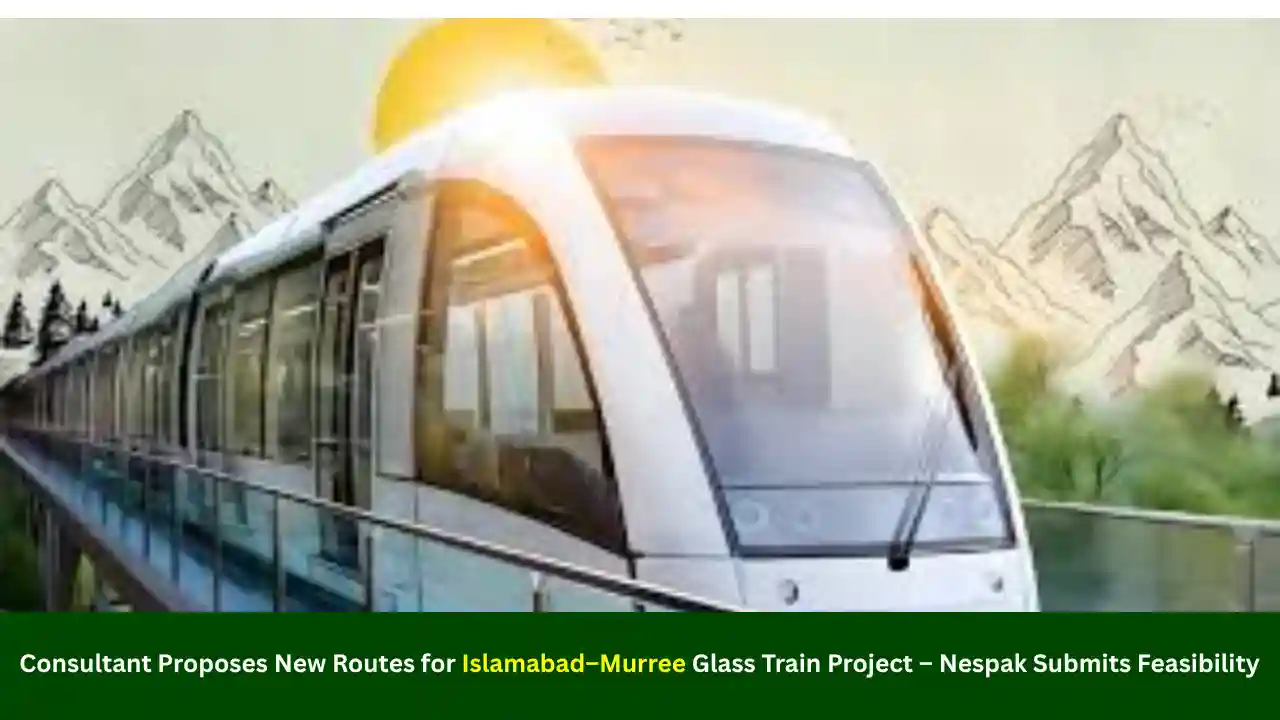
Under the current plan, the train will travel on a 40-kilometre elevated track between the Bhara Kahu Bypass and Pindi Point in Murree. Designed as a scenic monorail system, it will feature panoramic glass panels, enabling passengers to enjoy uninterrupted mountain views during the journey.
The Punjab government envisions the glass train as a sustainable alternative to traditional road transport, helping to curb vehicle emissions and protect the fragile ecosystem of the Murree hills while offering a world-class tourism experience.
Consultant’s New Proposal: Extension Toward the Airport
According to officials, the project consultant has now recommended a major enhancement — extending the route to Islamabad International Airport via Faizabad.
This extension would connect multiple parts of the capital with Murree and integrate the glass train line with existing and planned metro and public-transport infrastructure.
The idea was presented during recent coordination meetings attended by CDA Chairman Mohammad Ali Randhawa, the Chief Minister’s Adviser Shahid Ashraf Tarar, and Punjab government delegates.
Officials discussed using the existing metro bus corridor between Faizabad and the Airport as a shared right-of-way for the elevated monorail, reducing costs and minimizing land acquisition challenges.
Route Plan and Key Features
The consultant’s route map suggests:
| Section | Length (approx.) | Key Points | Status |
|---|---|---|---|
| Bhara Kahu Bypass → Pindi Point (Murree) | 40 km | Tourist route through hilly terrain | Feasibility approved |
| Faizabad → Bhara Kahu Bypass | 13 km | Connects to Lake View Park station | Proposed extension |
| Faizabad → Islamabad Airport | 25 km | Uses existing metro infrastructure | Under review |
| Rawat → Faizabad (Phase 2) | 30 km | Expressway integration | Future plan |
If implemented, this network would link Murree not only with Islamabad’s core areas but also with the airport and Rawat, enabling both tourists and residents to enjoy direct, high-speed, scenic travel across the region.
Lake View Park as the Central Station
Officials confirmed that Lake View Park will serve as the main station for the project, acting as a transit hub connecting the city to Murree.
The station will include:
- Dedicated parking for tourist buses and private vehicles.
- Ticketing counters and information booths.
- Waiting lounges with glass-roofed viewing areas.
- Shops and food outlets promoting local crafts and cuisine.
The CDA and Punjab government also plan to develop eco-friendly shuttle services to connect nearby attractions like Daman-e-Koh, Pir Sohawa, and Margalla Hills trails.
Environmental and Tourism Benefits
Experts describe the Islamabad–Murree glass train as a model project for sustainable mountain tourism in Pakistan.
By shifting thousands of vehicles off the Murree Expressway, the project aims to:
- Reduce traffic congestion and road accidents.
- Lower carbon emissions and improve air quality.
- Promote responsible tourism and protect the environment.
- Support local businesses by increasing tourist footfall in an organized manner.
Environmentalists note that the monorail’s electric propulsion system will significantly reduce dependency on fossil fuels, aligning with national green-energy goals.
Read Also: Breaking News: PM Shehbaz Sharif Increases Laptop Scheme Quota 2025 for University Students
CDA and Punjab Government’s Cooperation
During the high-level meeting, both CDA and Punjab government officials emphasized inter-provincial coordination as essential to the project’s success.
The CDA will handle the Islamabad portion, including alignment near Faizabad and Lake View Park, while the Punjab government will oversee construction from the Bhara Kahu Bypass to Murree.
Nespak has already completed the pre-feasibility phase and submitted its findings to both authorities. The report includes cost estimates, environmental-impact assessments, and technical design standards.
Proposed Use of Metro Infrastructure
One of the consultant’s key cost-saving suggestions is to use the existing Islamabad Metro Bus structure for part of the train’s route.
This would mean the glass train could run alongside or above the current metro line, particularly between Faizabad and Islamabad International Airport, utilizing the same corridor and support columns where feasible.
Such integration would:
- Save billions in infrastructure costs.
- Reduce land-acquisition hurdles.
- Allow passengers to transfer easily between metro and glass-train lines.
- Create a multi-modal urban transport system for the capital region.
Technical Specifications Under Review
While final technical details are under study, the train is expected to feature:
- Fully glazed carriages with 360-degree panoramic views.
- Electric propulsion for zero emissions.
- High safety standards, including earthquake-resistant design.
- Energy-efficient LED lighting and regenerative braking.
- A maximum speed of 80 km/h, ideal for tourist travel through hilly terrain.
The track will be elevated to minimize environmental disruption and ensure uninterrupted movement above traffic-heavy zones.
Phase-Wise Development Plan
Officials are considering a three-phase rollout:
- Phase 1 – Construction of the Bhara Kahu–Murree segment and Lake View Park terminal.
- Phase 2 – Extension to Faizabad and eventual integration with Islamabad Airport.
- Phase 3 – Long-term expansion to Rawat along the Expressway for inter-city connectivity.
Each phase will include local contractor involvement and technical supervision by Nespak to maintain safety and engineering quality.
Economic Impact
The Islamabad–Murree Glass Train Project is expected to generate significant economic and social benefits, including:
- Job creation during construction and operation.
- Increased domestic and international tourism.
- Growth of hospitality, retail, and real-estate sectors along the route.
- Promotion of Pakistan’s image as a hub for modern, sustainable infrastructure.
According to early estimates, the project could attract millions of visitors annually, especially during summer and winter holiday seasons.
Challenges and Considerations
While the proposal has been welcomed by many, experts have pointed out challenges that must be addressed before construction begins:
- Ensuring environmental sustainability in the fragile Margalla–Murree ecosystem.
- Coordinating inter-jurisdictional planning between CDA, Nespak, and Punjab government.
- Securing sufficient funding and private-sector investment.
- Maintaining affordability for both tourists and locals.
Authorities have emphasized that public consultations and environmental-impact studies will continue throughout 2026 before final approval.
A Symbol of Modern Pakistan
If implemented successfully, the Islamabad–Murree Glass Train could become a landmark infrastructure project — much like the Murree Expressway was in its time.
It would symbolize Pakistan’s shift toward innovation, sustainability, and integrated transport planning while preserving the natural beauty of the region.
Government officials have reiterated their commitment to advancing this project with transparency, technical precision, and environmental responsibility.
Conclusion About Islamabad Murree Glass Train Project:
The Islamabad–Murree Glass Train Project represents a bold step toward transforming Pakistan’s public transport and tourism landscape. With its modern design, electric technology, and eco-friendly approach, the project aims to offer travelers a comfortable, scenic, and sustainable way to reach one of the country’s most visited hill stations.
The proposal to extend the line to Faizabad and Islamabad International Airport shows the government’s vision for long-term connectivity and integration between urban transport and tourism infrastructure. Once completed, the project will not only ease traffic on the Murree Expressway but also promote clean energy, safe travel, and economic growth through tourism and local business development.
If implemented successfully, this landmark initiative will become a model for future green transport systems in Pakistan, demonstrating how innovation, engineering, and environmental responsibility can work together to shape a better, more sustainable future.
FAQs – Islamabad–Murree Glass Train Project
1. What is the Islamabad–Murree Glass Train Project?
It’s an elevated monorail system designed with glass-panel coaches to provide scenic travel between Islamabad and Murree.
2. Who is managing the project?
The project is being jointly overseen by the Punjab government, Capital Development Authority (CDA), and Nespak as the engineering consultant.
3. What is the total proposed length of the route?
The current plan covers 40 km between Bhara Kahu and Murree, with proposed extensions to Faizabad and Islamabad International Airport.
4. How will the project benefit the environment?
The glass train will use electric propulsion, reducing emissions and traffic on the Murree Expressway, thereby cutting smog and protecting the local ecosystem.
5. When will the project start?
Construction is expected to begin after final approvals and funding arrangements are completed, likely within 2026, following environmental clearance.