
Babar Azam Fined for ICC Code of Conduct Breach in 3rd ODI vs Sri Lanka – Full Details & ICC Action
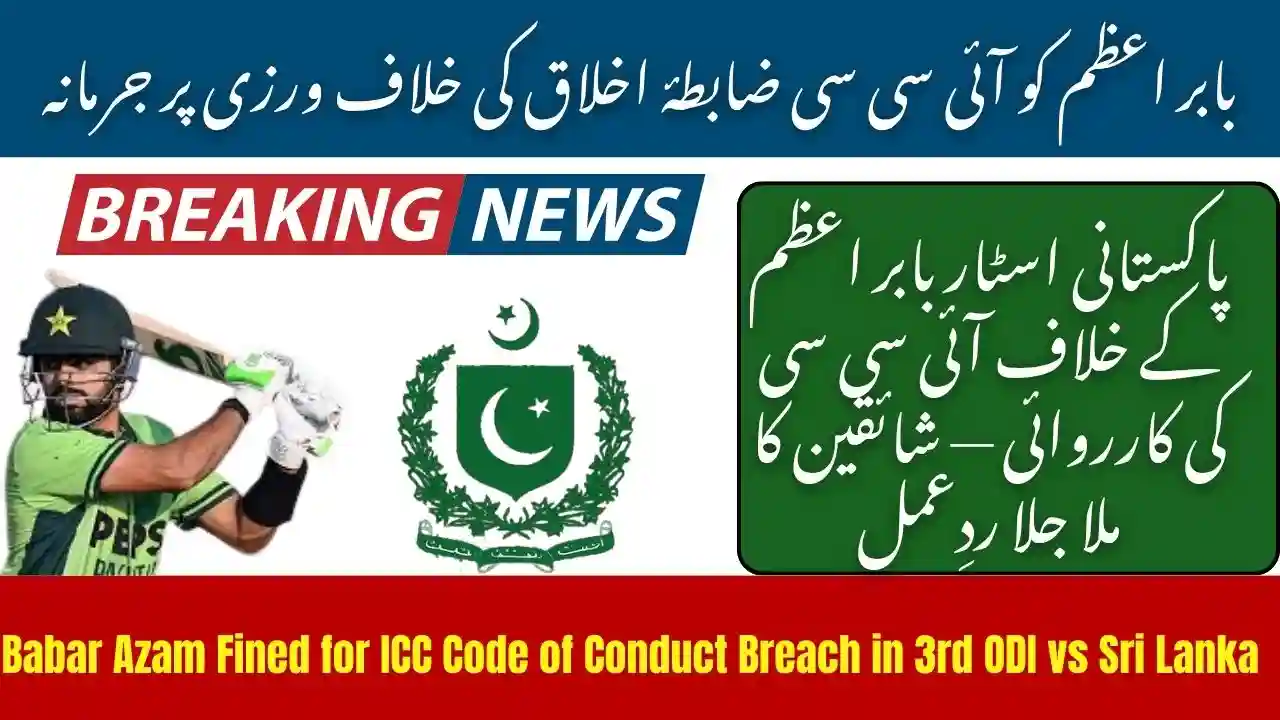
Babar Azam Fined for ICC Code of Conduct Breach in 3rd ODI vs Sri Lanka has been fined by the International Cricket Council (ICC) for a Code of Conduct breach during the third ODI against Sri Lanka. The decision has sparked discussions among fans, analysts, and cricket boards regarding the seriousness of ICC’s disciplinary rules and how even the biggest cricket icons are not exempt from penalties.
What Happened Between Babar Azam and ICC?
During the 3rd ODI between Pakistan and Sri Lanka, Babar Azam was involved in an incident that the ICC categorized as a Level 1 breach under its Code of Conduct. According to match officials, Babar displayed dissent after an umpiring decision went against him, reacting in a way that is prohibited under ICC’s disciplinary guidelines.
While Level 1 breaches are minor compared to Level 2 or Level 3 offenses, they still result in monetary penalties and demerit points, which stay on a player’s record for 24 months.
The ICC immediately reviewed the footage, match referee’s report, and statements, after which Babar was handed the fine.

Why ICC Fined Babar Azam – Key Details Explained
The ICC fine was imposed under Article 2.8 of the ICC Code of Conduct, which deals with:
This section applies when a player:
- Verbally disputes an umpire’s call
- Shows anger, frustration, or disappointment in an unacceptable manner
- Makes gestures that indicate disagreement with the umpire
- Delays the game intentionally after a decision
In Babar Azam’s case, the match referee reported visible “frustration and objection” after an LBW decision, which is considered unsporting behaviour according to ICC rules.

ICC Code of Conduct Level 1 Breach — What It Means
The ICC classifies breaches into 4 levels:
| Level | Severity | Penalty |
|---|---|---|
| Level 1 | Minor | Warning + 25%–50% match fee fine + 1 demerit point |
| Level 2 | Moderate | 50%–100% match fee fine + 1–2 demerit points |
| Level 3 | Serious | Suspension + demerit points |
| Level 4 | Very serious | Long suspension + heavy penalties |
Babar Azam’s breach falls under Level 1, meaning:
- No suspension
- No ban from upcoming matches
- Only financial deduction and one demerit point
But demerit points can add up and result in suspension if a player reaches 4 or more points within 24 months.

Full Breakdown of ICC’s Action Against Babar Azam
Below is a clear summary of ICC’s punishment:
✔ 1. Match Fee Deduction
Babar Azam was fined 25% of his match fee.
Match fee deductions are the ICC’s standard penalty for Level 1 breaches.
✔ 2. One Demerit Point Added
Babar received 1 demerit point, which stays on record for 24 months.
If a player collects 4 demerit points, they automatically face a 1-Test or 2-ODI or 2-T20I ban.
✔ 3. Official Record Updated
The ICC updated their disciplinary record, marking Babar’s breach.
✔ 4. No Formal Hearing
Since Babar accepted the charge immediately, no hearing was required.
This helped avoid further penalties or escalations.

Reaction of Pakistan Cricket Fans
The news generated a strong reaction on social media. Many fans expressed disappointment while others defended Babar, calling the reaction “normal frustration” that every player shows occasionally.
Popular opinions online include:
- “He is a human being; frustration happens.”
- “ICC is being too strict with senior Pakistani players.”
- “Babar should maintain discipline; he is a global icon.”
Regardless of reactions, the fine shows how strictly ICC implements on-field discipline.
Impact on Pakistan Team and Series vs Sri Lanka
Although the fine does not affect Babar’s participation, it holds importance for:
1. Pakistan Cricket Image
As Pakistan’s star batter, Babar carries major responsibility for on-field conduct.
2. Dressing Room Discipline
Senior players like Babar influence junior players through behavior.
3. Future ICC Monitoring
Once a player receives demerit points, they remain under closer observation.
However, the fine does not affect:
- Playing XI decisions
- Match availability
- Captaincy (if applicable)
- Performance statistics
Why ICC Takes Dissent Seriously — Explained for Cricket Fans
The ICC wants to protect:
✔ Umpires’ Authority
Cricket is a game where umpire decisions are final. Dissent undermines that authority.
✔ Spirit of the Game
Cricket prides itself on gentlemanly conduct.
✔ On-field Discipline
If players object openly, it sets a bad example for fans and junior cricketers.
✔ Match Flow
Dissent delays the match and causes unnecessary tension.
Therefore, ICC regularly fines players — even big names like Virat Kohli, Smith, Warner, Afridi, and now Babar.
Similar ICC Actions on Other Star Cricketers
Babar Azam is not the only high-profile player fined in recent years. Others include:
- Virat Kohli – Dissent and aggressive send-offs
- David Warner – Abuse of opposition players
- Ben Stokes – Verbal confrontation
- Shakib Al Hasan – Angry reaction to umpiring decision
- Shaheen Afridi – Throwing ball aggressively at batter
ICC’s consistent approach proves that no player gets special treatment.
Match Situation When Babar’s Incident Happened
The dissent occurred shortly after an LBW appeal against Babar was turned down by the umpire. Babar believed the ball had hit the pad before the bat, but the umpire disagreed.
Babar’s reaction, described as a visible expression of disagreement, was enough to trigger the disciplinary rule.
The match continued normally after a brief pause.
Was Babar Azam’s Reaction Justified? Balanced Analysis
✔ Arguments in Favour
- The decision was tight and debatable
- Players often react instinctively
- No harsh words or aggressive actions were used
- Frustration is natural in high-pressure matches
✔ Arguments Against
- Senior players must set discipline standards
- ICC rules are clear about dissent
- Cameras catch every expression
- Reactions influence younger players
In simple terms:
Emotions are normal, but ICC rules apply equally to all.
Will This Fine Affect Babar Azam’s Career?
No.
This is a minor Level 1 offense and has:
- No impact on selection
- No relation to captaincy
- No effect on performance
- No suspension
- No long-term consequences
It only becomes serious if more demerit points are accumulated.
How ICC Demerit Points Work — Full Guide
Understanding the ICC demerit system is important:
| Demerit Points | Result |
|---|---|
| 1–3 points | No suspension |
| 4 points | 1 Test or 2 ODIs/T20Is ban |
| 8 points | 2 Tests or 4 ODIs/T20Is ban |
| 12 points | Long-term suspension |
Babar currently has 1 point, which is safe.
Read Also: HEC PhD Scholarships in USA 2026 Announced – Fully Funded Seats in Top 100 Universities
Public Statement from PCB and Babar Azam
The PCB (Pakistan Cricket Board) acknowledged ICC’s action but described it as “a routine matter”. Reports suggest that Babar has privately accepted the penalty and moved on.
Neither PCB nor Babar issued a long public statement, which is normal for Level 1 cases.
Media Coverage & Global Reactions
International media highlighted the incident as:
- A reminder of ICC’s strict protocols
- Evidence of increasing player frustration in modern cricket
- A sign of competitive intensity in the Pakistan–Sri Lanka series
Cricket analysts also commented on how cameras and replays make all player reactions highly visible.
Conclusion — ICC’s Message to Players
The ICC’s fine to Babar Azam reinforces a clear message:
For fans, this incident is small and routine. For players, it is a reminder to stay composed, especially in high-pressure matches.
Babar Azam remains one of the world’s top batters, and this minor penalty does not change his standing in international cricket.
FAQs — Babar Azam ICC Fine:
1. Why was Babar Azam fined by ICC?
He was fined for showing dissent at an umpire’s decision during the 3rd ODI vs Sri Lanka.
2. How much was Babar Azam fined?
He was fined 25% of his match fee.
3. Did Babar get a ban for this breach?
No, this is a Level 1 offense. Only a fine and one demerit point were issued.
4. What ICC rule did Babar Azam violate?
Article 2.8 – Showing dissent at umpire’s decision.
5. How many demerit points does Babar have now?
He now has 1 demerit point.
6. Will this affect Babar Azam’s future matches?
No, he is fully available to play.
7. Are other players also fined for similar breaches?
Yes, many star players have been fined for dissent and on-field behaviour.
8. What happens if a player collects 4 demerit points?
They face automatic suspension from matches.