
Breaking: Azad Kashmir Right of Way Fees Removed to Boost Digital Growth
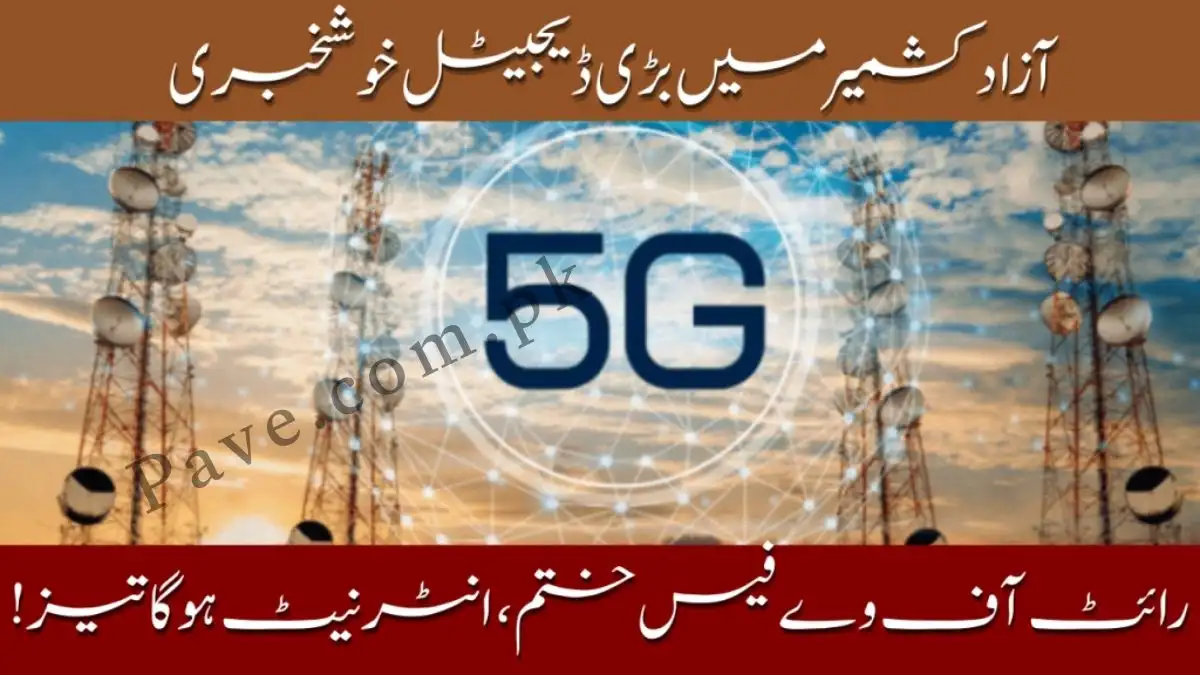
In a landmark decision aimed at accelerating digital transformation, the Azad Jammu and Kashmir (AJK) government has officially abolished Right of Way (RoW) fees for telecommunication and IT infrastructure projects. The move, effective as of February 20, 2026, is being described as a cornerstone of the broader “Digital AJK” vision.
This policy shift is expected to dramatically speed up fiber optic deployment, tower installations, and broadband expansion across mountainous and underserved regions of AJK.
What Are Right of Way (RoW) Fees?
Right of Way fees are charges imposed by government departments for:
- Laying fiber optic cables along roads
- Installing telecom towers on public land
- Using government-controlled infrastructure corridors
Previously, these fees were calculated per meter or per pole, significantly increasing operational costs for telecom operators and ISPs.
With the 2026 reform, RoW charges in AJK are now officially Rs. 0.

Key Highlights of the 2026 Policy Reform
The announcement was confirmed by AJK Prime Minister Faisal Mumtaz Rathore, in coordination with the Pakistan Telecommunication Authority (PTA).
Zero RoW Charges
Telecom operators and Internet Service Providers (ISPs) are now fully exempt from:
- Per-meter fiber installation fees
- Tower placement charges on government land
- Administrative levies related to telecom expansion
This eliminates one of the largest financial bottlenecks in infrastructure development.
One-Window NOC System
To reduce bureaucratic hurdles:
- All No-Objection Certificates (NOCs) will now be processed through the Deputy Commissioner’s office
- Maximum processing time: 15 days
This replaces the previous multi-department approval system that often caused months of delays.
Deemed Approval Clause
To ensure accountability:
- If no objection is raised within 15 days
- The application is considered automatically approved
This “deemed approval” model is expected to eliminate unnecessary administrative stalling.

Multi-Billion Rupee Fiber Optic Project Launch
Officials have confirmed that a large-scale fiber optic expansion project will begin immediately after Eid-ul-Fitr 2026.
The project aims to:
- Extend high-speed broadband to remote valleys
- Upgrade legacy copper networks to fiber
- Prepare infrastructure for 5G rollout
This marks one of the most ambitious digital infrastructure drives in AJK’s history.

Why This Policy Matters for Digital Growth
Experts believe the removal of RoW fees will have far-reaching economic and technological impacts.
5G Readiness in AJK
The PTA has indicated that a separate 5G spectrum auction for AJK and Gilgit-Baltistan (GB) is expected within months.
By eliminating RoW costs:
- Telecom companies face lower capital expenditure
- Investment appetite increases
- Competitive bidding becomes more attractive
This makes AJK significantly more appealing for operators planning 5G deployment.
More Affordable Internet Packages
With reduced infrastructure costs, telecom operators such as:
- SCO
- Jazz
- Zong
are expected to lower operational expenses.
In theory, this should translate into:
- More competitive data packages
- Lower broadband installation charges
- Expanded coverage in rural districts
Boost for Freelancers & Digital Economy
High-speed internet is critical for:
- Freelancers working on global platforms
- IT startups
- Online education
- Telemedicine services
- E-governance systems
AJK has a growing youth population engaged in digital services, and reliable broadband could significantly increase export earnings from freelancing.

AJK vs National Digital Policy – 2026 Comparison
AJK’s reform follows a similar federal directive issued in late 2025, where national entities like:
- National Highway Authority (NHA)
- Pakistan Railways
abolished RoW charges across their networks.
Policy Comparison Table
| Feature | Previous Status | New Status (2026) |
|---|---|---|
| RoW Fee | High (Per meter/pole) | Rs. 0 (Waived) |
| NOC Timeline | Months / Indefinite | Max 15 Days |
| Infrastructure Focus | Copper Networks | Fiber Optic & 5G |
| Primary Beneficiaries | Government Revenue | Youth & Tech Sector |
Strategic Importance of Northern Connectivity
AJK’s geography presents unique challenges:
- Mountainous terrain
- Sparse rural settlements
- High installation costs
By removing RoW fees, the government reduces:
- Initial capital barriers
- Investment hesitation
- Project approval delays
This is especially important for remote districts where connectivity gaps remain significant.
Impact on Investment Climate
International and domestic investors often evaluate:
- Regulatory stability
- Infrastructure cost predictability
- Approval timelines
The 2026 RoW waiver improves AJK’s ranking in these areas, positioning it as an emerging digital corridor in northern Pakistan.
What’s Next for Gilgit-Baltistan?
Reports indicate that the Gilgit-Baltistan government is reviewing similar reforms. Discussions are underway with the Law Department to abolish comparable charges.
If implemented, the entire northern belt could see synchronized digital expansion.
Final Outlook – Digital AJK 2026 and Beyond
The abolition of Right of Way fees marks a structural transformation in AJK’s telecom policy. By removing financial and bureaucratic hurdles, the region is positioning itself for:
- Accelerated fiber optic rollout
- Early 5G adoption
- Expansion of digital entrepreneurship
- Improved broadband affordability
If implementation proceeds smoothly, AJK could emerge as one of the fastest-growing digital regions in northern Pakistan over the next few years.