Breaking News: NEPRA Replaces Solar Net Metering with Net Billing
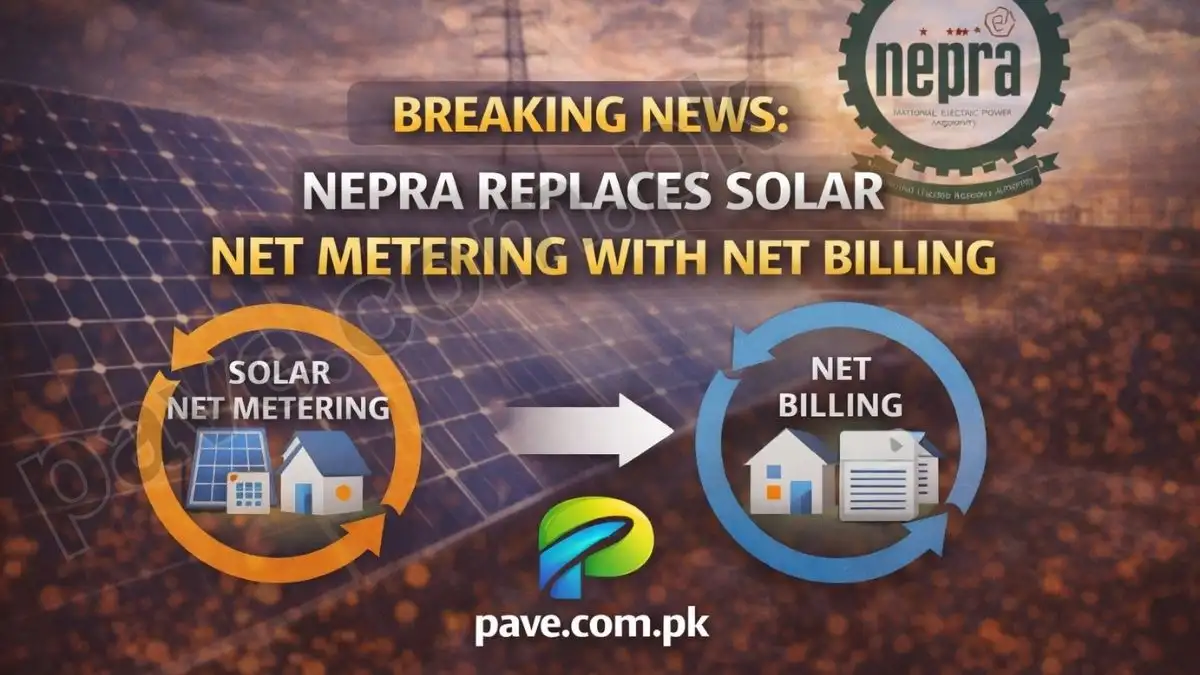
On Monday, February 9, 2026, National Electric Power Regulatory Authority (NEPRA) officially notified the NEPRA (Prosumer) Regulations, 2026, ending the decade-old net metering system and replacing it with a net billing framework.
This decision directly affects millions of current and future solar users, sharply reducing the financial advantage of exporting electricity to the national grid.
Below is a clear, ultra-detailed, no-confusion breakdown of what changed, why it happened, who is affected, and what solar users should do now.
1. The Core Shift: From Units to Money
The most important change is how electricity is valued.
Old System: Net Metering (2015 Rules)
- Export 1 unit during the day
- Import 1 unit free at night
- Bill calculated on net units only
- Grid acted like a free battery
New System: Net Billing (2026 Rules)
You are now treated as two separate roles:
Buying from the grid
- Charged full retail tariff
- Rs. 40–55 per unit (including taxes, surcharges)
Selling to the grid
- DISCO buys surplus at NAEPP
- Rs. 9–11 per unit
Reality check:
You sell cheap. You buy expensive.

2. Net Metering vs Net Billing (Side-by-Side)
| Feature | Net Metering (2015) | Net Billing (2026) |
|---|---|---|
| Adjustment method | Unit-for-unit | Cash credit |
| Export value | ~Rs. 25–27/unit | ~Rs. 9–11/unit |
| Import cost | Same unit offset | Rs. 40–55/unit |
| Contract duration | 7 years | 5 years (renewable) |
| Rate stability | Fixed for contract | NEPRA can revise |
| System size | Up to 1.5× load | Max 100% load |
| Transformer rule | Flexible | Blocked at 80% |

3. Who Is Affected (And When)
New Solar Applicants
- Any application after Feb 9, 2026
- Net billing only
- No net metering option remains
Existing Net Metering Users
- Existing 7-year agreements remain valid
- However:
- Billing methodology may shift to net billing immediately
- Until contract expiry, exports credited at Power Purchase Price (~Rs. 26)
- After renewal → Rs. 9–11 rate applies to everyone
Government & Public Buildings
- Net metering already suspended at multiple government sites
- Used as a live test for grid revenue recovery

4. Why NEPRA Ended Net Metering
NEPRA and the Power Division cited three core reasons:
Capacity Payments
Solar users avoided paying fixed costs of IPPs (Independent Power Producers).
Cost Shifting
Non-solar, low-income consumers were effectively subsidizing the grid for solar households.
Grid Instability (Duck Curve)
- Excess solar during daytime
- Heavy demand after sunset
- Technical and financial stress on DISCOs
In simple terms:
The grid couldn’t afford being a free battery anymore.

5. What This Means for Solar Users
Longer Payback Period
- Old solar ROI: 3–4 years
- New expected ROI: 7–9 years
Exporting Power Is No Longer Smart
Selling at Rs. 11 and buying back at Rs. 50 is a loss-making loop.
6. What Solar Experts Recommend Now
1. Hybrid Solar Systems
- Add battery storage
- Use your own power at night
- Export minimum energy to the grid
2. Load Shifting
Run heavy appliances during daytime:
- Air conditioners
- Water pumps
- Irons, ovens, washing machines
3. Treat Grid as Backup
The grid is no longer your savings tool.
It’s now just emergency support.
7. Key Terms (Simple Explanation)
- Prosumer: Consumer + producer of electricity
- NAEPP: National Average Energy Purchase Price
- DISCO: Power distributor (LESCO, MEPCO, IESCO, etc.)
- Sanctioned Load: Approved electricity capacity
- Capacity Payments: Fixed IPP costs, even if no power is used
Bottom Line
Yes — net metering is effectively over in Pakistan.
The 2026 NEPRA regulations mark a permanent shift:
From unit swapping
To cash settlement
From grid dependence
To self-consumption
If you plan solar in 2026 or later, battery storage is no longer optional.