New Visa-Free Entry Rules for Pakistan and Somalia Diplomatic Passport Holders
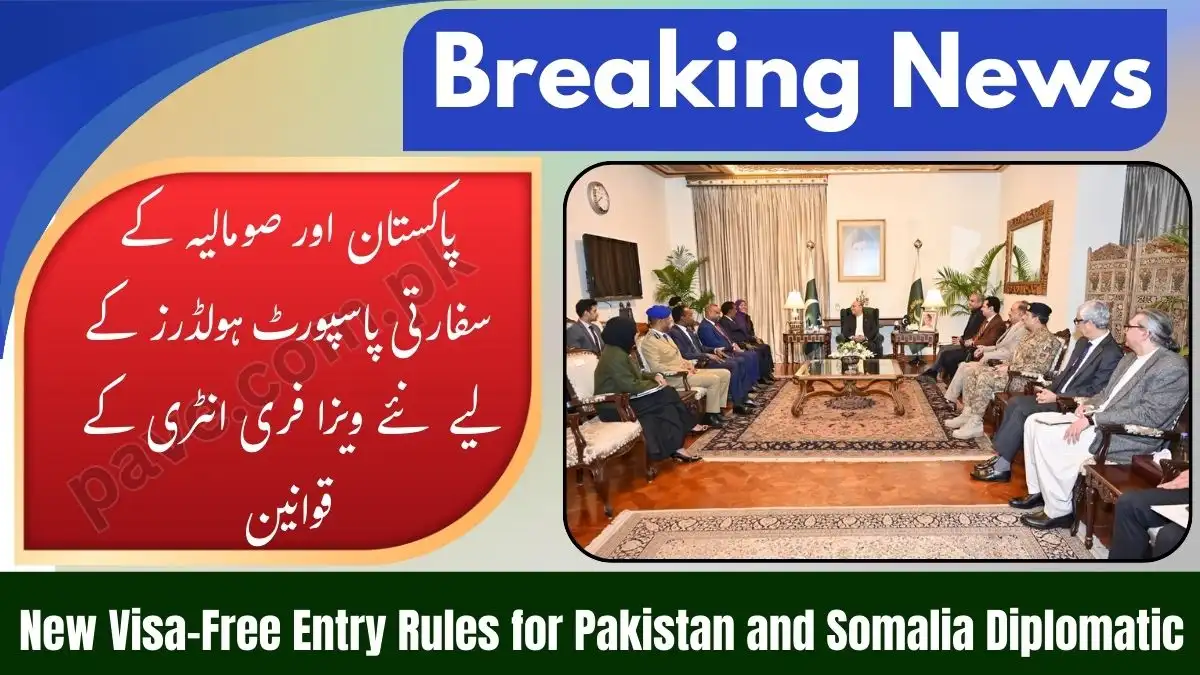
Pakistan and Somalia have taken a major diplomatic step forward by signing a visa waiver agreement for diplomatic and official passport holders, marking a rare and highly symbolic moment in bilateral relations that had remained largely dormant for decades.
This agreement is not just about visas. It reflects a broader reset in Pakistan–Africa relations, with Somalia emerging as a key strategic partner in East Africa.
1. Key Details of the Agreement
Who Signed the Agreement
- Hamza Adan Haadoow
Permanent Secretary, Ministry of Foreign Affairs of Somalia - Dawood Muhammad Baraech
Special Secretary, Ministry of Interior & Narcotics Control, Pakistan
Witnesses at the Signing
The ceremony, held in Islamabad, was formally witnessed by:
- Asif Ali Zardari, President of Pakistan
- Ali Yousuf, Interior Minister of Somalia
Their presence elevated the agreement from a routine bureaucratic step to a presidential-level diplomatic commitment.

2. A Historic Moment: First Visit in 35 Years
This event marked the first official bilateral visit by a Somali delegation to Pakistan in 35 years, underlining how significant the agreement is in diplomatic terms.
- Last comparable engagement dated back to the late 1980s
- Signals a revival of long-standing but underutilized ties
- Opens doors for sustained political, security, and institutional cooperation
📌 In diplomatic circles, such long gaps followed by high-level engagement usually indicate strategic recalibration, not symbolism alone.

3. Beyond Visas: Areas of Cooperation Agreed
While the visa waiver applies to diplomatic and official passport holders, discussions went much further.
Agreed Cooperation Areas
- Law enforcement collaboration
- Criminal justice coordination
- Counter-narcotics operations
- Joint action against organized and transnational crime
- Capacity building for internal security institutions
These areas align closely with Somalia’s current internal stabilization priorities and Pakistan’s institutional strengths.

4. Strategic Importance for Pakistan
Pakistan’s Africa Strategy
President Asif Ali Zardari used the occasion to clearly state that:
- Africa is central to Pakistan’s global outlook
- Pakistan intends to expand political, security, and institutional engagement with African states
- Somalia is viewed as a gateway partner in East Africa
This fits into Pakistan’s broader effort to diversify diplomatic partnerships beyond South Asia and the Middle East.
Security & Institutional Support
Pakistan formally offered:
- NADRA assistance for Somalia’s identity management and civil registration systems
- Training programs for the Somali police force
- Knowledge sharing in border control, documentation, and population data systems
📌 NADRA’s involvement is particularly significant, as it is considered one of Pakistan’s most globally respected technical institutions.
5. Shared History & Symbolic Recognition
Somalia’s Interior Minister Ali Yousuf highlighted the historical bond between the two countries:
- Acknowledged Pakistan as a reliable partner since Somalia’s independence
- Paid tribute to Pakistani peacekeepers who served in UN missions in Somalia during the 1990s
- Recognized Pakistan’s sacrifices in support of Somali stability during difficult years
This acknowledgment adds emotional and historical depth to the renewed partnership.
6. Why This Agreement Matters Now
This development comes at a time when:
- Somalia is rebuilding its state institutions
- Pakistan is expanding diplomatic engagement with Africa
- Security cooperation and migration management are global priorities
The agreement lays groundwork for:
- Easier high-level diplomatic exchanges
- Faster coordination on security matters
- Potential future expansion to business, technical, and cultural exchanges
Final Assessment
The Pakistan–Somalia visa waiver agreement is far more than a travel facilitation measure. It represents:
- A reset of bilateral relations
- A strategic opening for Pakistan in East Africa
- A trust-based partnership focused on security, governance, and institutional capacity