
Socio-Economic Survey Extended Till March 31, 2026
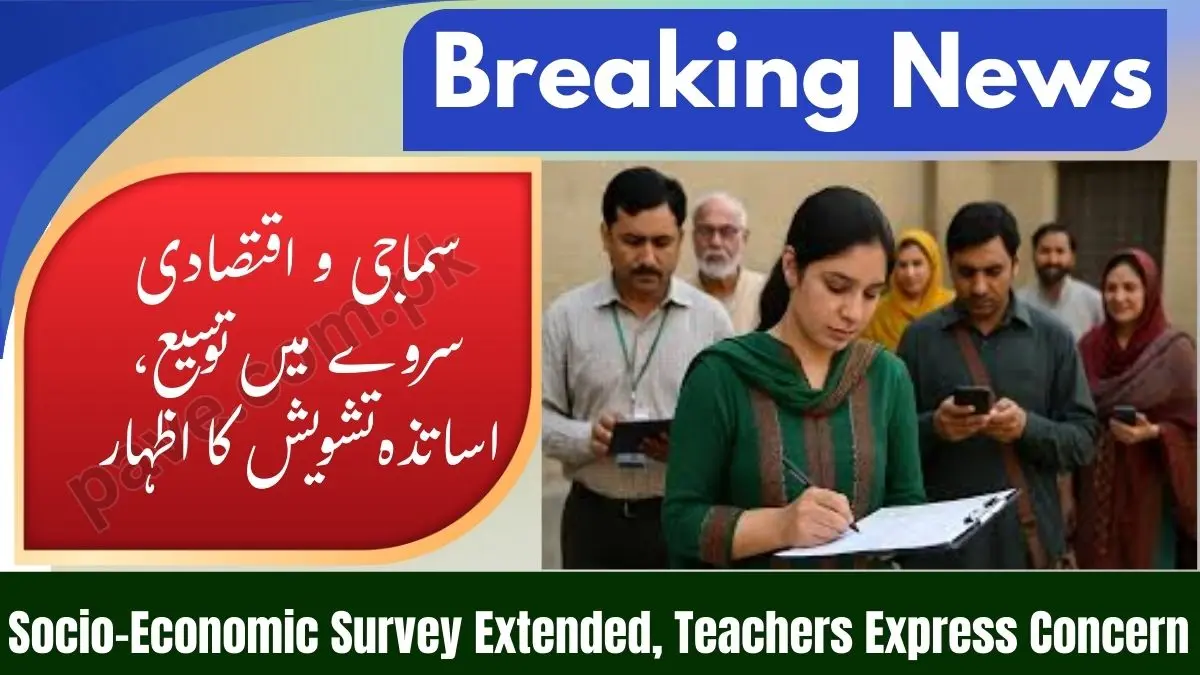
The Government of Punjab has officially extended the ongoing Socio-Economic Survey by three months, shifting the deadline from December 31, 2025 to March 31, 2026. The survey—being conducted through The Urban Unit in coordination with Benazir Income Support Programme (BISP)—is central to updating the 8171 database for 2026 welfare disbursements.
While the extension is framed as a move to protect vulnerable households from exclusion, it has triggered strong resistance from the teaching community, who warn that prolonged field deployment will directly undermine students’ academic outcomes, especially with Annual Exams approaching in March.
Why the Survey Was Extended
Provincial authorities argue the decision is essential to meet welfare coverage targets and improve data integrity:
- 100% Coverage Goal: Officials aim to ensure no deserving household is left out of BISP assistance.
- Data Verification: Additional time is required to re-verify households in remote and peri-urban areas to keep the 8171 registry accurate for 2026.
- Unregistered Families: Thousands of eligible families remain unsurveyed, risking exclusion from the Rs. 13,500 quarterly installment under BISP Kafalat.
From the government’s perspective, the extension is a last-mile inclusion measure—but one that shifts the burden heavily onto teachers.

Teachers’ Core Concerns: “Classrooms Are Paying the Price”
Roughly 12,000 teachers across Punjab are currently assigned door-to-door survey duties. The Punjab Teachers Union (PTU) has formally objected, citing the following critical issues:
1) Academic Disruption
- The extension overlaps with the most crucial teaching window before March examinations.
- Teachers warn of learning loss and incomplete syllabus coverage, particularly in Matric and Intermediate feeder classes.
2) Unsustainable Workload
- Balancing full-day teaching with field surveys has led to physical fatigue and mental burnout.
- Digital data collection glitches further extend working hours.
3) Accountability Fears
- Educators fear they will be held responsible for weak exam results despite months of diversion to non-academic tasks.
4) Safety & Logistics
- Female teachers report difficulties accessing unfamiliar localities.
- Lack of official transport and on-ground security remains a major concern.

Government Concessions After Union Pressure
Following protests and negotiations, the Punjab government announced limited relief:
- Holiday Compensation: Rs. 4,000 per day for survey duties on Sundays and public holidays.
- Technical Support: The Urban Unit has been instructed to improve tablet performance and IT back-end support to reduce downtime.
While welcomed, unions say these steps do not address the root issue—the diversion of teachers from classrooms.

Survey at a Glance
| Metric | Details |
|---|---|
| Personnel Deployed | ~12,000 Teachers |
| Original Deadline | Dec 31, 2025 |
| New Deadline | March 31, 2026 |
| Holiday Allowance | Rs. 4,000 / day |

What Happens Next?
The PTU has signaled the possibility of a “pen-down strike” if:
- Teacher numbers are not reduced, or
- Dedicated clerical/data staff are not hired to complete remaining survey work.
The Education Department, however, maintains the survey is a “national priority” and must be completed by March to safeguard welfare payments.
Parents’ Concern: A Growing Learning Gap
With winter vacations recently extended till January 19 and teachers engaged in survey work, parents fear a compounded learning gap. Many are urging the government to adopt a balanced deployment model—protecting social welfare goals without sacrificing classroom instruction.
Bottom Line
The survey extension underscores a classic policy dilemma: social protection vs. educational continuity. Unless workload distribution is recalibrated—by bringing in non-teaching field staff—Punjab risks solving one equity problem while creating another in education outcomes.