
Pakistan Unveils Locally Developed Anti-Drone Gun ‘Sufra’ – A Major Step Toward Defense Innovation 2025
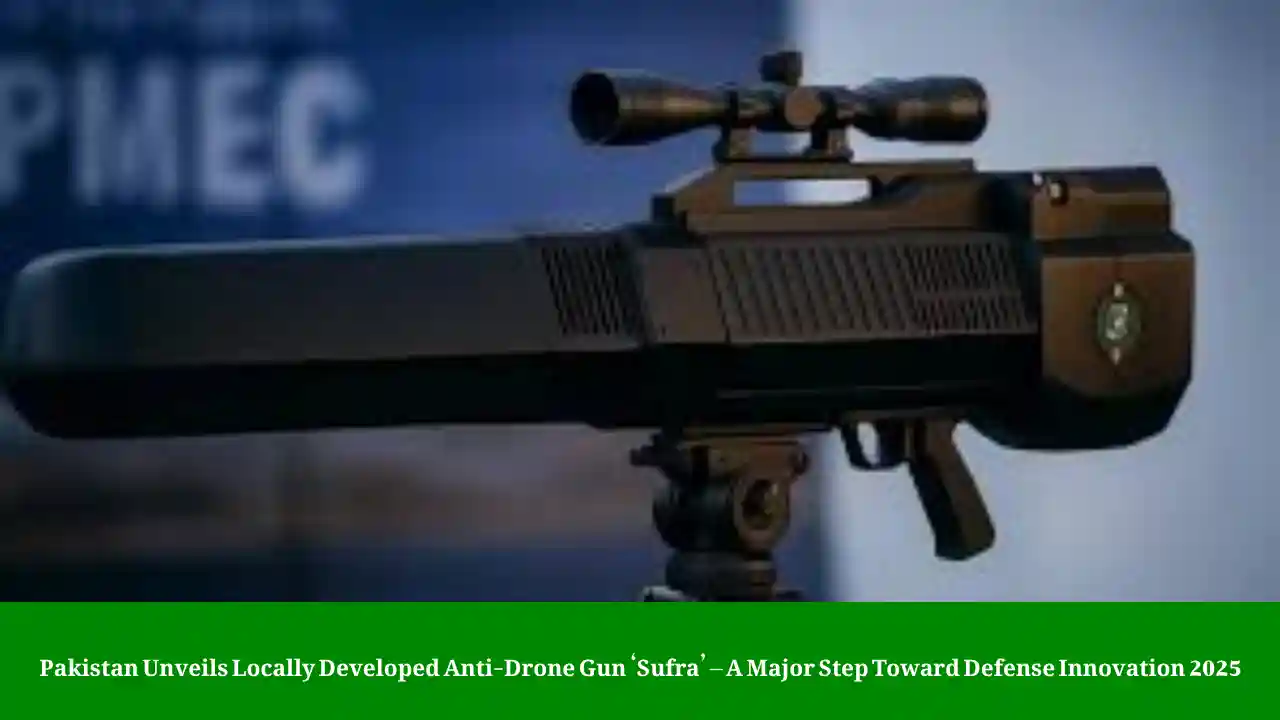
Pakistan has officially launched its first locally developed anti-drone jamming gun, named Sufra, designed to neutralize and disable hostile drones within seconds.
This innovation marks a major breakthrough for Pakistan’s defense technology, demonstrating the country’s growing ability to develop indigenous counter-drone systems amid rising cross-border threats and surveillance challenges.
Introduction – Pakistan’s Breakthrough in Drone Defense Technology
The Sufra Anti-Drone Gun 2025 was unveiled at the Karachi Maritime Expo, where it drew significant attention from defense experts and security officials.
Developed by engineers at the National Electronics Complex, the weapon is a portable, tactical electronic countermeasure system capable of disabling drones and blocking communication between the aircraft and its operator within a radius of 1.5 kilometers.
With global conflicts increasingly involving drones for surveillance, spying, or attacks, the launch of this locally made anti-drone solution places Pakistan among the growing list of countries building indigenous drone-defense capabilities.
Specifications of Sufra Anti-Drone Gun
The Sufra gun has been specifically engineered to provide frontline tactical support to defense and law-enforcement agencies.
Here are its key specifications and capabilities:
| Feature | Details |
|---|---|
| Type | Portable Electronic Counter-Drone Weapon |
| Effective Range | Up to 1.5 Kilometers |
| Coverage Angle | Adjustable up to 30 Degrees |
| Primary Function | Jam Communication and GPS Links of Enemy Drones |
| Target Handling | Multiple Drone Neutralization at Once |
| Operational Mode | Handheld / Vehicle-Mounted |
| Developer | National Electronics Complex of Pakistan (NECOP) |
| Deployment Areas | Border Security, Military Bases, Public Events |
The Sufra anti-drone system uses electromagnetic interference to jam frequencies that control drones, forcing them either to land safely or lose contact with their command stations.
This gives military and security forces a non-lethal and effective way to counter aerial threats without collateral damage.
How the Sufra Anti-Drone Gun Works
The system operates by emitting a targeted radio-frequency beam that disrupts communication signals between a drone and its operator.
Once the communication is jammed:
- The drone loses control and either crashes or lands automatically.
- In some cases, Sufra can even take control of the drone mid-flight.
- The 30-degree adjustable field of operation allows the operator to cover wide areas quickly.
Unlike conventional firearms, Sufra doesn’t rely on bullets or explosives — it uses advanced signal-blocking technology, making it safer for use in populated areas or near sensitive facilities.
Read Also: Breaking News: Government Announces Local Holiday in Sindh District
Demonstration at Karachi Maritime Expo
The Karachi Maritime Expo 2025 served as the perfect platform for Sufra’s debut.
Defense personnel and international observers witnessed a live demonstration of the system’s ability to jam and neutralize drones mid-air.
Observers noted that the weapon efficiently tackled multiple drone threats simultaneously, confirming its advanced software and real-time response capability.
The display also included simulations of border security operations, where Sufra’s high precision and quick response were key highlights.
Officials from Pakistan’s defense establishment stated that the Sufra Anti-Drone Gun will soon be deployed in border regions and urban security operations to protect against potential aerial incursions or terrorist drone attacks.
Why Pakistan Needed an Anti-Drone Solution
Over the past few years, Pakistan has faced increasing threats from cross-border drone incursions — including smuggling attempts, spying activities, and potential weaponized drone attacks.
The rise of “kamikaze” drones in regional conflicts has further highlighted the need for an indigenous defense system.
Experts say that Pakistan’s borders with India and Afghanistan are particularly vulnerable to surveillance drones, while urban centers require protection during mass public events and VIP movements.
Developing the Sufra system locally not only strengthens Pakistan’s defense readiness but also reduces dependence on imported counter-drone technologies, which are often expensive and restricted due to international regulations.
Potential Applications of the Sufra System
The Sufra Anti-Drone Gun can be deployed in a variety of environments:
- Border Areas: To intercept cross-border smuggling or surveillance drones.
- Military Installations: Protecting air bases, command centers, and ammunition depots.
- Critical Infrastructure: Securing airports, power plants, and communication hubs.
- Public Events: Enhancing security during political gatherings or sports events.
- Law Enforcement: Supporting police and paramilitary forces during high-risk operations.
Officials have hinted that multiple versions of the Sufra gun are being developed, including vehicle-mounted and fixed-site models for long-range coverage.
Read Also: Breaking News: Japan Announces Fully Funded ADB Scholarship 2025 for Pakistani Students
Defense Industry Response
The unveiling of Sufra has been widely praised by defense experts, engineers, and military analysts.
They view it as a significant step toward self-reliance in defense manufacturing, aligning with Pakistan’s long-term goal of “Made in Pakistan” defense solutions.
Defense analyst Major (R) Farooq Haider commented that such technologies are essential for modern warfare:
“The future battlefield is dominated by drones. Having a local solution like Sufra shows that Pakistan is ready to face electronic and asymmetric warfare challenges.”
He further added that the cost-effective production of Sufra makes it a viable export candidate for friendly nations facing similar threats.
Government’s Focus on Indigenous Defense Innovation
The development of the Sufra Anti-Drone Gun is part of Pakistan’s broader strategy to modernize its defense and security infrastructure.
Prime Minister Shehbaz Sharif and the Ministry of Defense Production have repeatedly emphasized the importance of technological independence.
The National Electronics Complex of Pakistan (NECOP), along with other defense research bodies, is now focusing on building indigenous systems in:
- Cybersecurity and Artificial Intelligence
- Drone Detection and Counter-Drone Systems
- Electronic Warfare Equipment
- Smart Surveillance and Robotics
This aligns with Pakistan’s National Defense Innovation Vision 2030, which seeks to reduce import dependency and promote local manufacturing and R&D excellence.
Regional Context – Drone Wars in South Asia
In South Asia, drone warfare has become a growing concern.
Countries such as India, Iran, and Turkey are rapidly developing their own counter-drone technologies.
- India has already introduced systems capable of intercepting small drones used for surveillance or payload delivery.
- Turkey’s Aselsan and Iran’s Meraj systems have become regional leaders in anti-drone warfare.
By introducing the Sufra Anti-Drone Gun, Pakistan now joins this league of technologically capable nations, showing that it can independently produce tactical-level electronic warfare tools.
Strategic Impact for Pakistan’s Security
The deployment of Sufra will help Pakistan:
- Strengthen Border Security – Counter illegal drone crossings and smuggling activities.
- Protect Sensitive Locations – Airports, military bases, and government buildings.
- Boost Counter-Terrorism Operations – Prevent drone-based reconnaissance or attacks.
- Enhance Surveillance Efficiency – Provide frontline troops with better electronic warfare tools.
Experts also believe that Sufra’s introduction will lead to international collaborations with countries seeking affordable and reliable counter-drone solutions.
Read Also: Breaking News: Punjab Govt Announces Final Decision on Increasing Electric Bus Ticket Price
Future Developments – Upgrades and Export Potential
The National Electronics Complex is reportedly working on upgraded versions of Sufra with enhanced range (up to 3 km) and integrated AI-based target recognition.
These versions could detect and jam drones automatically, even before they enter restricted airspace.
There are also plans to export Sufra guns to friendly countries in Asia, Africa, and the Middle East, once mass production begins.
Such defense exports would help Pakistan earn valuable foreign exchange, support its industrial base, and enhance its strategic image as a self-reliant technology producer.
Public and Expert Reactions
The announcement of the Sufra system has generated widespread attention on social media and in defense circles.
Pakistanis have hailed it as a sign of progress in indigenous innovation, with many praising the engineers behind the project.
Defense communities online have also compared Sufra’s features with similar Western systems like DroneGun Tactical (Australia) and SkyWall (UK), concluding that Sufra offers competitive performance at a fraction of the cost.
Read Also: Saudi Arabia-Bound PIA Flight Makes Emergency Landing at Karachi Airport 2025
Conclusion – A New Era for Pakistan’s Defense Technology
The Sufra Anti-Drone Gun 2025 is more than just a weapon — it’s a symbol of Pakistan’s growing technological confidence.
By developing such systems locally, Pakistan has taken a major leap toward self-reliance in defense production and modern warfare preparedness.
As global threats evolve, tools like Sufra will play a crucial role in safeguarding borders, protecting critical assets, and empowering security forces.
The innovation demonstrates that Pakistan’s defense engineers are capable of delivering world-class solutions that meet both military and civilian needs.
Trending FAQs About Sufra Anti-Drone Gun Pakistan 2025
1. What is the Sufra Anti-Drone Gun developed by Pakistan?
The Sufra Anti-Drone Gun is a locally made jamming weapon created by Pakistan’s National Electronics Complex. It is designed to disable enemy drones by blocking communication signals between the drone and its operator. The system can neutralize drones from up to 1.5 kilometers away, forcing them to land or lose control completely.
2. What is the range and capability of Pakistan’s Sufra Anti-Drone Gun?
The Sufra system has an effective range of 1.5 km and covers a 30-degree adjustable angle. It can target and disable multiple drones simultaneously, making it suitable for both military and urban security operations.
3. Where will Pakistan deploy the Sufra Anti-Drone Gun?
Authorities have confirmed that the Sufra Anti-Drone Gun will be deployed along Pakistan’s borders to counter cross-border drone threats. It will also be used during public events, at airports, and for critical infrastructure security to prevent unauthorized drone activity.
4. Who manufactured the Sufra Anti-Drone Gun in Pakistan?
The Sufra system was developed by the National Electronics Complex of Pakistan (NECOP) — an advanced defense and electronics organization working under Pakistan’s defense production division. The project reflects Pakistan’s growing self-reliance in defense innovation.
5. Why did Pakistan develop its own anti-drone system?
Pakistan developed the Sufra Anti-Drone Gun in response to rising cross-border drone incursions, smuggling attempts, and spying operations. The goal is to protect national security, strengthen border defense, and reduce reliance on expensive imported counter-drone technologies.